
 Generative AI
If you've been reading about AI, machine learning, or chatbots lately, you've probably come across the word embeddings. It sounds fancy, but the idea behind it is actually pretty simple.
In this post, I'll explain embeddings, how they are created, and why almost every modern AI system depends on them.
So? what exactly is an embedding?
An embedding is just a way of turning information into numbers. Not random numbers?but numbers that represent meaning.
In simple terms, an embedding is a list of numbers that represents what something means.
For example, these two sentences mean almost the same thing:
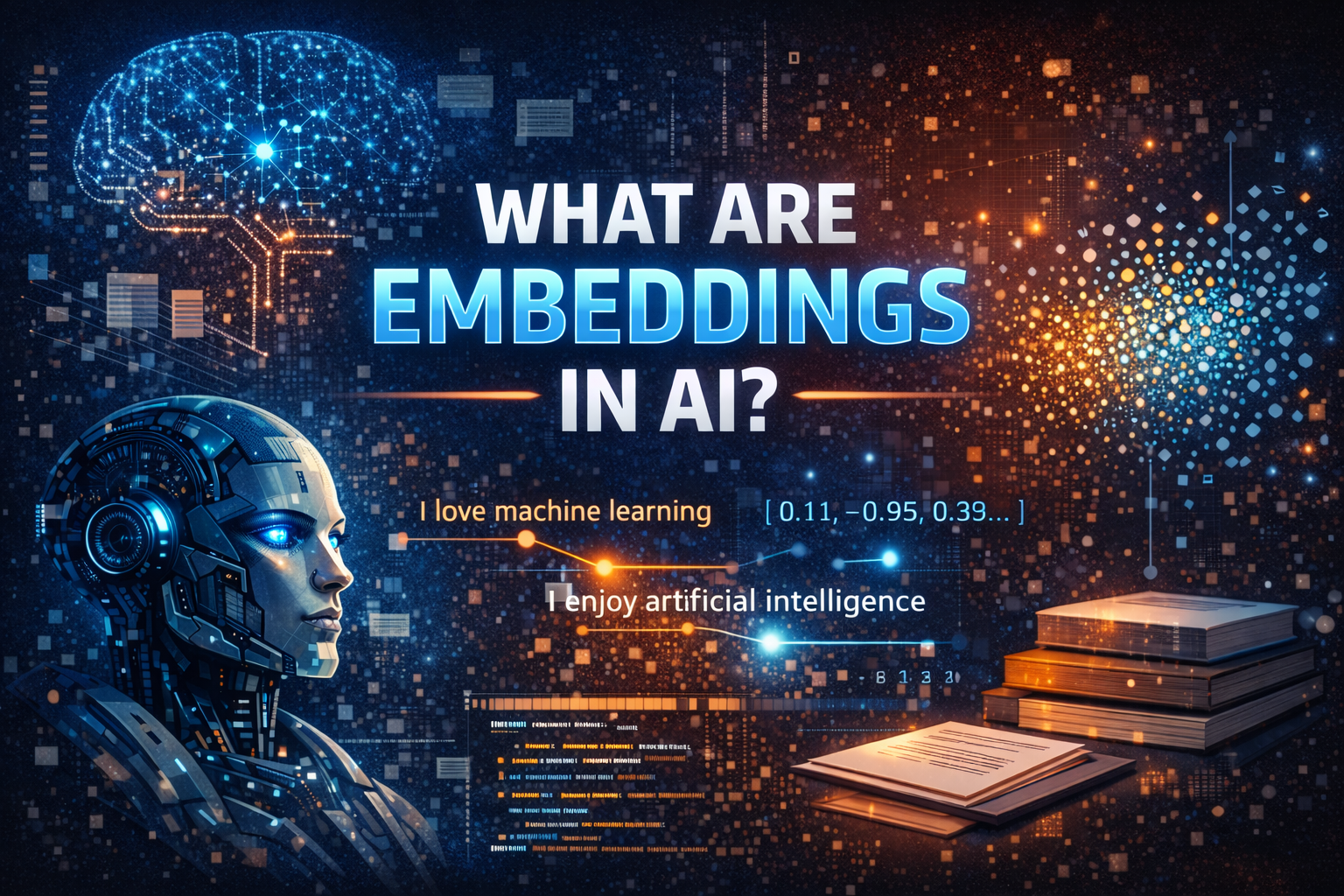
- I love machine learning
- I enjoy artificial intelligence
Even though the words are different, embeddings for these sentences will be very close to each other. That's how computers know they're related.
I love machine learning  ? [0.12, -0.98, 0.33, ...]
I enjoy artificial intelligence ? [0.11, -0.95, 0.30, ...]
Why do embeddings matter so much?
Before embeddings, most systems worked using simple keyword matching. That approach breaks down very quickly in the real world.
Embeddings fix this by helping machines understand intent instead of just words.
- Search results become more accurate
- Chatbots give more relevant answers
- Recommendations feel more ?human?
- Duplicate or similar content is easier to detect
How are embeddings actually created?
Modern embeddings are usually generated using transformer-based models. You don't need to understand all the math, but the flow looks like this:
- The text is broken into smaller pieces called tokens
- Each token is converted into a vector
- The model looks at surrounding words to understand context
- All token vectors are combined into one final vector
Text ? Tokens ? Model ? Single Vector (Embedding)This is why the word bank means different things in ?river bank? and ?bank loan?. Context matters.
Embeddings vs normal keyword search
A quick comparison makes things clearer:
- Keyword search: looks for exact words
- Embeddings: look for meaning
That's why embeddings are used in semantic search and RAG systems.
A small Python example
Here's a very basic example using an open-source embedding model. You don't need a GPU to try this.
pip install sentence-transformersfrom sentence_transformers import SentenceTransformer
model = SentenceTransformer("all-MiniLM-L6-v2")
sentences = [
"I love machine learning",
"I enjoy artificial intelligence",
"The weather is hot today"
]
embeddings = model.encode(sentences)
print(len(embeddings[0])) # 384Each sentence is now represented as a 384-dimensional vector.
Checking similarity between sentences
from sentence_transformers import util

score = util.cos_sim(embeddings[0], embeddings[1])
print(score.item())
A higher score means the sentences are closer in meaning.
Where embeddings are used in real projects
If you're building a RAG system, this flow will look familiar:
Documents ? Embeddings ? Vector Database
User Question ? Embedding ? Similarity Search ? Answer
This is how modern AI assistants ?look things up? before answering.
Quick takeaway
- Embeddings turn meaning into numbers
- They are generated using transformer models
- They make search, chatbots, and recommendations smarter
