
 Machine Learning
Machine Learning (ML) is a branch of Artificial Intelligence (AI) where computers learn from data and improve with experience-without you writing every rule manually. Instead of "if-else" rules for everything, an ML model finds patterns in examples and uses them to make predictions.
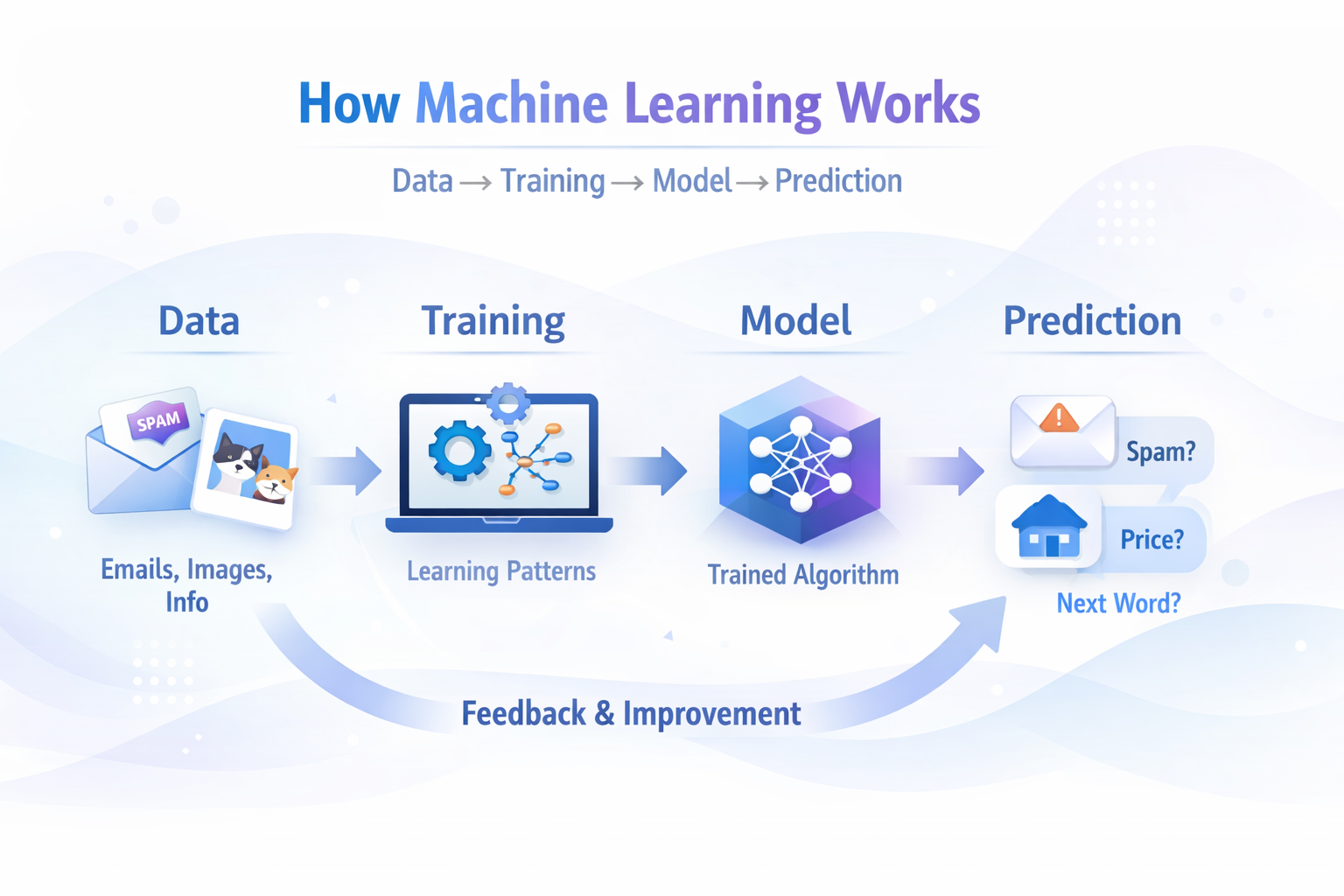
Machine Learning in One Picture
Machine Learning Definition (Simple Words)
Machine Learning is a way to make computers learn from examples. You provide data, the system studies it, and then it can predict outcomes or make decisions for new inputs. That’s why ML is used in recommendations, fraud detection, search ranking, image recognition, and chatbots.
How Machine Learning Works (Step-by-Step)
- Collect data: The more relevant and clean the data, the better the model can learn.
- Prepare data: Remove noise, handle missing values, and choose useful features.
- Train a model: The algorithm learns patterns by trying to reduce errors.
- Test & evaluate: Check performance using metrics like accuracy or error rate.
- Deploy & improve: The model keeps improving using feedback and new data.
Types of Machine Learning
1) Supervised Learning
In supervised learning, you train the model using labeled data (data where the correct answer is known). Example: predicting house prices using past house price data.
2) Unsupervised Learning
In unsupervised learning, the model gets unlabeled data and tries to discover patterns by itself. Example: grouping customers into segments based on behavior.
3) Reinforcement Learning
In reinforcement learning, the model learns by trial and error. It gets rewards for correct actions and penalties for wrong ones. Example: game-playing AI or robotics navigation.
Real-Life Examples of Machine Learning
- Recommendations: YouTube/Netflix suggesting videos or movies
- Spam detection: Identifying spam emails automatically
- Fraud detection: Detecting suspicious banking transactions
- Computer vision: Face unlock and object detection
- Generative AI support: ML techniques help models understand patterns in text and images
Machine Learning vs Traditional Programming
Traditional Programming
Input + Rules → Output
You manually write rules for every situation. This becomes hard when the problem is complex (like language or images).
Machine Learning
Input + Output examples → Learns Rules (Model)
The model “figures out” rules from data and can handle real-world complexity better.
FAQs about Machine Learning
Is Machine Learning the same as AI?
Not exactly. AI is the bigger umbrella. Machine Learning is one way to build AI systems using data-driven learning.
Do I need coding to learn Machine Learning?
Basic coding helps a lot (Python is common), but you can understand ML concepts first without heavy coding.
Where is Machine Learning used the most?
ML is widely used in recommendations, finance (fraud), healthcare, marketing, search engines, and GenAI applications.