
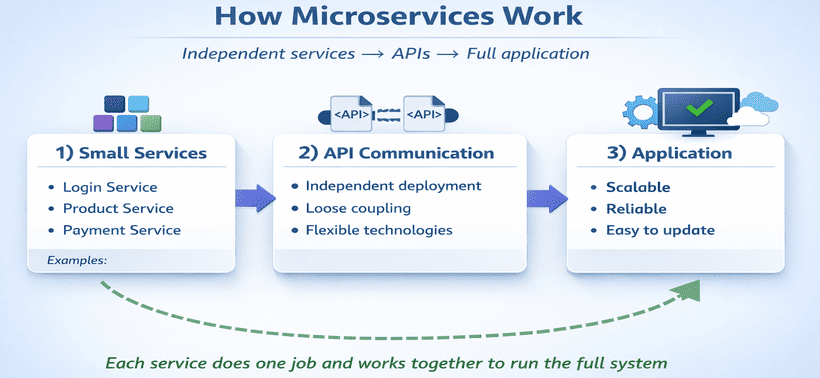
What are Microservices? Microservices, also called microservice architecture, is a way of building a large application by dividing it into many small, independent services.
How Microservices Work
Microservices Definition
Microservices, also called microservice architecture, is a way of building a large application by dividing it into many small, independent services.
Each service is responsible for one specific business function and works on its own. These services communicate with each other using APIs or other lightweight communication methods.
Because each service is separate, developers can build, update, deploy, and scale them independently. This makes the application easier to manage, especially when the system becomes large and complex.
Microservices in Simple Words
In simple words, instead of building one big application that handles everything, developers break the application into many small parts.
Each small part does one job only.
- User Service: Handles user login, signup, and profile.
- Product Service: Manages product details and categories.
- Order Service: Handles orders and order tracking.
- Payment Service: Processes payments.
- Notification Service: Sends emails, SMS, or alerts.
All these services work together to make the full application run smoothly.
So, microservices are like a team where each member has a separate responsibility, but all members work together to complete the full task.
Login Service → API
Product Service → API
Order Service → API
Payment Service → API
Notification Service → API
Why Microservices Are Used
Microservices are used because large applications become difficult to manage when everything is built in one single codebase.
As the application grows, it becomes harder to update features, fix bugs, scale the system, manage teams, and deploy changes safely.
Microservices solve this by dividing the system into smaller services, so each part can be handled more easily.
Key Characteristics of Microservices
- Independent Deployment: Each service can be updated, fixed, tested, or deployed separately without affecting the whole application. For example, if you want to update the payment service, you do not need to redeploy the product or login service.
- Small and Focused Services: Each microservice is built for one particular business task only, such as authentication, cart, payment, or inventory. This makes the code easier to understand and maintain.
- Loose Coupling: Services are connected, but they are not tightly dependent on each other. This means changes in one service usually do not break the others if the communication contract remains the same.
- Technology Flexibility: Different services can use different technologies based on what is best for that service. For example, one service may use Node.js, another may use Python, one may use MongoDB, and another may use MySQL.
- Independent Scalability: Only the service that needs more resources can be scaled. For example, if the payment service gets heavy traffic during a sale, only that service can be scaled instead of scaling the entire system.
- Separate Data Management: In many microservice systems, each service manages its own database. This helps services remain independent and reduces direct dependency between modules.
Real-Life Example of Microservices
Imagine an online shopping app. Instead of making one large system, it can be split into multiple services.
- User Service: Handles login, signup, and profile management.
- Product Service: Handles product details and categories.
- Cart Service: Manages the shopping cart.
- Order Service: Creates and tracks orders.
- Payment Service: Processes payments.
- Notification Service: Sends email or SMS updates.
If the payment system needs changes, developers can update only the payment service without touching the other services.
Benefits of Microservices
- Better Fault Tolerance: If one service fails, the entire application does not always fail. For example, if the notification service stops working, users may still be able to place orders and make payments.
- Faster Development: Different teams can work on different services at the same time, which speeds up feature development and release cycles.
- Easier Maintenance: Since each service is small and focused, it is easier to understand, debug, and improve.
- Better Scalability: Only the services that need extra performance can be scaled, which saves infrastructure cost and improves efficiency.
- Faster Deployment: A single service can be deployed without redeploying the full application, making releases faster and safer.
- Technology Choice: Teams can choose the best language, framework, or database for each service.
- Supports Large Applications Well: Microservices are useful for large systems where many teams work together and the application keeps growing.
Challenges of Microservices
- More Complex to Manage: A microservices system has many separate services, so managing them is harder than managing one monolithic application.
- Harder Data Consistency: Since different services may use different databases, keeping data synchronized can be difficult. For example, if payment succeeds but order creation fails, handling consistency becomes more complex.
- Communication Overhead: Services communicate over a network, which can add delay and make the system slower compared to direct function calls inside a single application.
- Difficult Debugging: When an error happens, it may involve multiple services, so tracing the issue becomes harder.
- Deployment and DevOps Complexity: Microservices usually need strong DevOps support, such as Docker, Kubernetes, API gateway, centralized logging, monitoring tools, and CI/CD pipelines.
- Testing Is More Difficult: Testing a distributed system is harder because many services interact with each other.
Benefits:
• Easy scaling
• Faster deployment
• Better maintenance

Challenges:
• More complexity
• Network delay
• Harder debugging